



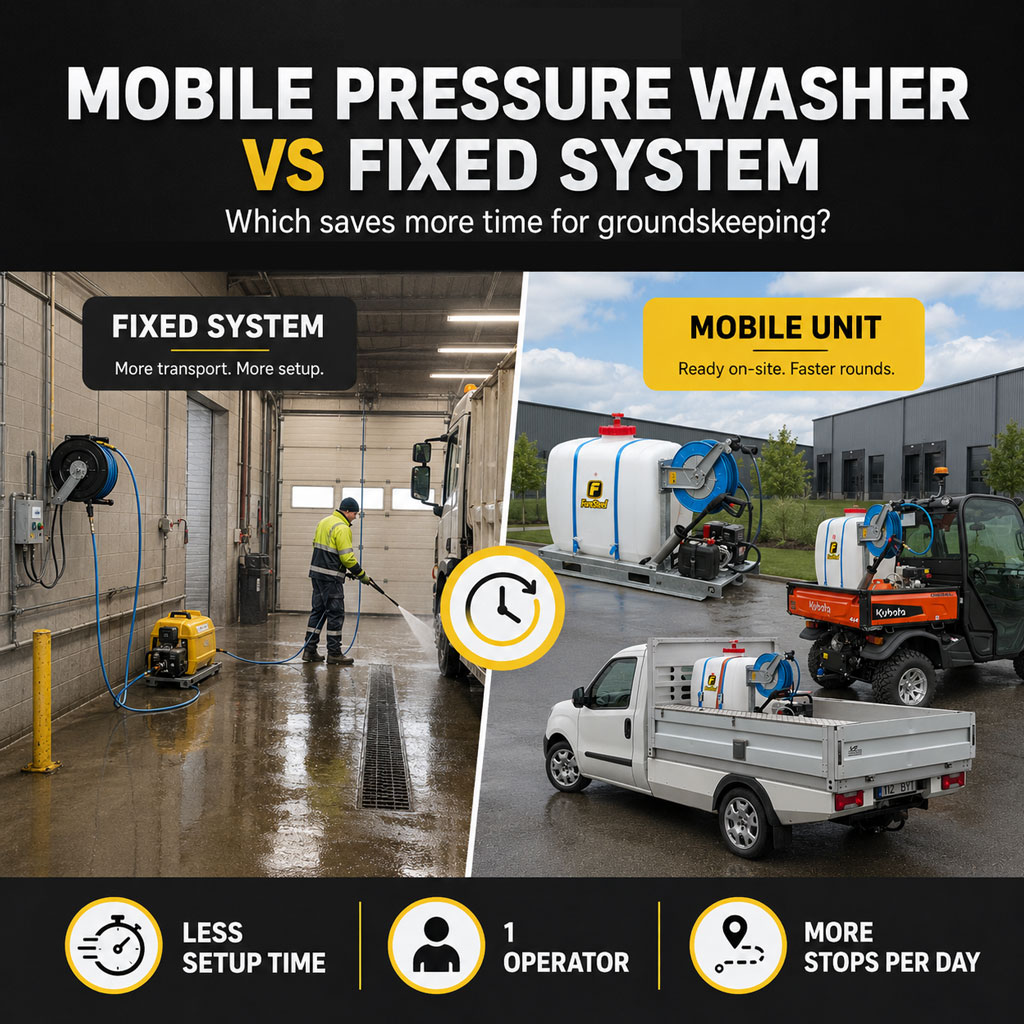
Mobile Pressure Washer vs Fixed System: Which Saves More Time for Groundskeeping?
For professional groundskeeping teams, the question is not whether you need a pressure washer — it is whether a fixed installation or a mobile self-contained unit is the more efficient investment. If your cleaning tasks are spread across multiple locations (bus stops, park furniture, playground equipment, road signs, fleet vehicles), a mobile unit with an integrated water tank almost always saves more time.
The Core Problem: Access to Water and Power
Traditional pressure washers need two things at the job site: a water supply and a power source. For a workshop wash bay, this is straightforward. But the majority of groundskeeping cleaning tasks happen in the field — bus shelters along roadsides, benches distributed across parks, playground equipment far from any tap.
Moving dirty items to a central wash bay is theoretically possible but practically expensive. The transport time often exceeds the washing time. A mobile pressure washer solves this by carrying everything needed — water tank, pressure pump, chemical dosing, and hose system — on a single compact unit that goes where the work is.
Time Comparison
Fixed system (wash bay): Transport item or equipment to wash bay (or run extension cords and hoses to site): 20–45 min setup per location. Wash: 15–30 min. Clean up / return: 15–30 min. Total per location: 50–105 minutes, usually requiring 2 workers.
Mobile unit: Drive to location with pressure washer loaded on UTV, pickup, or trailer: transit time only. Setup on arrival: under 5 minutes (the system is always ready). Wash: 15–30 min. Move to next location. Total per location: 20–35 minutes, 1 worker.
A single operator with a mobile unit typically completes 8–12 bus shelters per day. The same task with a fixed system and transport logistics might cover 4–6 with a 2-person crew.
Tank Capacity: 300L vs 600L
Professional mobile pressure washers are available in two common tank sizes. A 300-liter tank provides approximately 30–45 minutes of continuous washing — enough for several bus stops, a playground, or a fleet of utility vehicles. It is lighter, fits on smaller vehicles (including UTVs, golf carts, and compact vans), and is easier to maneuver.
A 600-liter tank doubles the working time between refills. It suits operations with fewer refill opportunities or longer routes between water sources. The trade-off is additional weight when full.
Both sizes typically feature self-contained gasoline-powered pumps (no external power needed), forklift pockets for quick loading/unloading onto any vehicle, and optional trailer conversion kits for towed operation.
Vehicle Flexibility
A well-designed mobile pressure washer fits on whatever vehicle is available that day — the same UTV used for leaf collection, a pickup truck, a flatbed trailer, a van, or an electric utility cart. Forklift pockets allow loading and unloading in minutes. This means no dedicated vehicle is needed, and the pressure washer integrates into your existing fleet alongside other attachments like leaf vacuum trailers.
When a Fixed System Is Still Better
Fixed wash bays remain the right choice for high-volume fleet washing operations (multiple vehicles daily at the same location), facilities with water recycling requirements, and operations where all items can practically be brought to one point. If you wash heavy equipment at a depot every day, a fixed bay with water recovery makes sense.
ROI Example
A municipality cleaning 40 bus shelters quarterly. Traditional method: 2-person crew, 5–7 working days per quarter. Mobile unit: 1 person, 3 days per quarter. Annual labor savings: approximately 40–60 person-hours. At typical municipal labor costs, the mobile pressure washer pays for itself in the first year.
Explore mobile cleaning solutions: See the Foresteel PW-300 and PW-600 mobile pressure washers, or read about year-round equipment strategies for grounds maintenance teams.


 Compact, efficient professional equipment