



We Put a Camera Inside the Box and Vacuumed 15 Different Materials
Most debris loader specifications give you horsepower and housing diameter. Neither answers the question you actually have: will it take the material on my site, and what happens to it once it does?
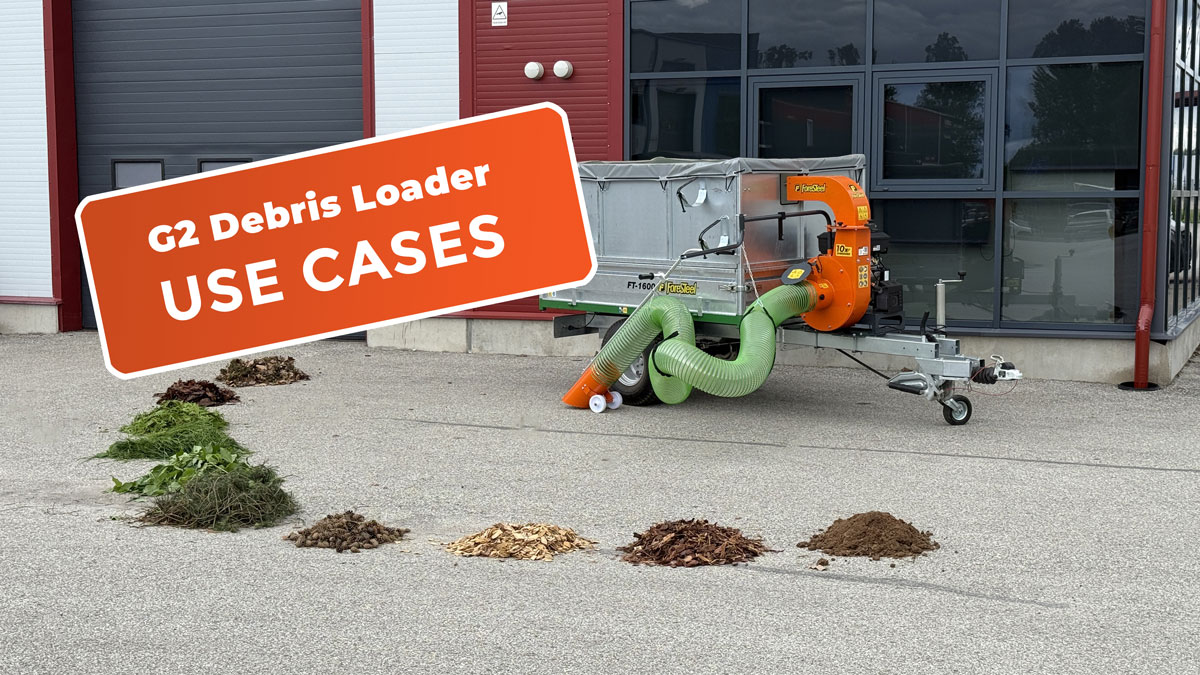
So we mounted a camera inside the tipper box of a Foresteel FT-1600 and ran fifteen different materials through the G2 debris loader in one continuous take. The result is a split screen — the suction nozzle on one side, the inside of the load on the other – so you see the moment each material is drawn in and how it packs down.
No cuts between materials, no separate takes. One run, one machine. What follows is what the footage shows, and why each result matters on a working site.
Why film inside the box?
The interesting part of a debris loader is not the nozzle. It is the actual material journey from the nozzle to the dump box, where three things happen in about a second:
- The material is accelerated by airflow
- It passes the Hardox® impeller and the active shredder blade
- It hits the replaceable Hardox® wear liner and drops into the box
Everything that matters commercially happens in that second. How far the volume drops. How hard the material hits the housing. Whether wet or fibrous material passes cleanly or wraps.
Those three parts — impeller, shredder blade, wear liner — are the second-generation upgrades that define the range. The full G2 series overview covers the specification, the standard equipment and what changed from the previous generation.
The split screen is the point: nozzle and load, at the same moment.
The 15 materials
Timestamps match the video, so you can jump to whichever material is the one you’re actually worried about.
| Time | Material | Why it’s in the test |
|---|---|---|
| 0:10 | Dry leaves | The baseline. Highest volume, lowest density — where the shredder earns its keep. |
| 0:17 | Wet leaves | The real autumn condition. Heavier, matted, and the case that stalls underpowered machines. |
| 0:30 | Hedge trimmings | Long and springy. The hardest green waste to compact by hand. |
| 0:43 | Long grass | Fibrous and wrap-prone. Passes cleanly or it doesn’t. |
| 0:50 | Shrub cuttings | Mixed stem thickness — the everyday output of a maintenance round. |
| 0:56 | Conifer branches | Woody, rigid, awkward. The material most people assume a vacuum can’t take. |
| 1:08 | Pine cones | Hard, dense, irregular. High-velocity impact on the liner and a classic blockage candidate. |
| 1:14 | Wood chippings | Abrasive at volume. Relevant well beyond leaf season. |
| 1:25 | Mulch | Moving landscaping material, not just removing waste. |
| 1:35 | Dry compost | Fine, dusty, light — the opposite end of the range from gravel. |
| 1:40 | Event waste | Mixed and unsorted, the way public-space cleanup actually arrives. |
| 1:48 | Litter | Parks, car parks, verges, roadside. |
| 1:52 | Foam & insulation | Construction and renovation sites. Light, bulky, and miserable to collect by hand in wind. |
| 2:00 | Sawdust | Timber yards, workshops, tree work. |
| 2:05 | Gravel | The durability test. The heaviest, most abrasive material in the run, and the one that separates a Hardox® body from a thin housing. |
Three groups, in effect: green waste (leaves through dry compost), site and event cleanup (event waste, litter, foam, insulation, sawdust), and abrasion (gravel).
What the shredder does to volume
The most visible thing in the footage is what happens to bulk on the way in.
Loose dry leaves are mostly air. A 2.5 m³ body filled with unshredded leaves holds 2.5 m³ of leaves and a great deal of nothing. Run the same material past the active shredder blade and the same body holds the equivalent of roughly 10 m³ of loose dry leaves.
That’s not a suction statistic. It’s a routing statistic:
- Four trips to the green waste site become one
- More ground covered before the body is full
- Lower fuel and vehicle hours per cubic metre collected
- Less handling at the tip
On a municipal route with a 20-minute round trip to the disposal site, that’s most of a working day recovered, every week of the season.
Read next: The science of 10× volume reduction · Why shredding leaves saves time
Branches, cones and gravel — the durability question
Leaves don’t kill debris loaders. Everything else does.
Gravel and small stones, conifer branches, pine cones, wood chippings and other debris all arrive at the housing at speed, and they’re abrasive. This is the difference between a machine still working in season eight and one needing a rebuild in season two — and it’s invisible from outside, which is exactly why it’s worth filming.
Three things absorb that punishment on a Foresteel G2:
The replaceable Hardox® wear liner. The liner takes the abrasion instead of the housing. When it’s done its work you unbolt it and fit a new one. Without a liner that wear goes into the housing itself — and the housing is the machine. Thin housings typically wear through in one to two seasons of active use.
The Hardox® impeller. Holds its geometry, and therefore its suction, under heavy material. A thinner turbine warps and quietly loses airflow across seasons. The blade is also self-cleaning by design — material sheds instead of building up, which keeps the impeller balanced and the airflow steady.
The Hardox® shredder blade. Does the volume reduction, and is a replaceable service item rather than a welded-in part.
The gravel at the end is a margin test, not a use case. It shows the machine handles the stones and grit that arrive mixed into real green waste. Continuous stone vacuuming is a different job and needs a different machine.
Read next: Hardox and replaceable liners: the secret to the G2’s low cost of ownership · What to look for in a professional debris loader
How much suction is actually there?
Horsepower doesn’t describe suction. And numbers rarely give you the full picture. Actual airflow and suction power does — it determines how far from the nozzle the machine will lift material, and how it copes when that material is wet.
The practical benchmark: a Foresteel G2 lifts objects of roughly 15 kg through the nozzle. Not because anyone needs to vacuum 15 kg objects, but because it tells you what’s left in reserve when the material is soaked leaves, wet clippings or a bag of site waste on a Tuesday in November.
Both G2 units run Briggs & Stratton Vanguard™ commercial engines — 14 HP on the MIDvac G2, 18 HP on the PROvac G2 — chosen for holding rated speed under a dense load rather than for peak figures.
Read next: Why we standardised Vanguard™ power for the G2 series
What this means for your site
Municipalities and public works. Material never arrives sorted. Leaves, litter, event waste, grit and hedge trimmings turn up together, and a machine that only handles leaves is a machine that stops twice an hour. Municipal leaf collection guide →
Landscapers and greencare contractors. The list is the year-round argument. Hedge trimmings and shrub cuttings in summer, long grass in spring, leaves in autumn, mulch and chippings whenever. A single-purpose machine sits idle for ten months. How contractors scale leaf cleanup →
Golf courses and estates. Conifer branches and pine cones are the difficult end of this list, and they’re exactly what falls on mature parkland. Turf-safe, low ground pressure, and the same machine handles clippings and aeration cores.
Sports grounds. Grass clippings before a fixture are the version of this problem with a deadline attached. We ran a full-size pitch to find out what that takes: 7,700 m² mowed and collected in 51 minutes.
Property and facility managers. Event waste, litter, foam and insulation cover the gap between grounds maintenance and site cleanup — usually two separate subcontractors.
Tree surgeons, timber and construction. Sawdust, chippings and offcuts. Not a segment we designed for, but it’s in the video because the machine handles it.
Which machine ran this test?
The video shows an FT-1600 leaf vacuum trailer, which carries the G2 debris loader as its vacuum unit. It’s the same G2 unit whether you buy it standalone or built into a trailer.
- MIDvac G2 — 14 HP Vanguard™. Property managers, smaller municipalities, estates, shared-use contractors.
- PROvac G2 — 18 HP Vanguard™. Full-season professionals, large municipal routes, heavy contractors.
- FT-1600 leaf trailer — the machine in this video. Vacuum, shred, haul and tip in one unit.
- All complete leaf trailers — FT-600, FT-1600 and FT-2200 T3.
A standalone G2 loads into a dump body you already own — tipping trailer, pickup bed, municipal truck. A complete leaf trailer is the answer when you don’t have one, or when you want a machine that becomes a tipping trailer once the season ends. Leaf trailer vs debris loader →
Tell us what you maintain, what you tow with and what you collect today, and we’ll come back with a configuration rather than a catalogue. Contact us →
FAQ – Frequently Asked Questions
Hedge trimmings, long grass, shrub cuttings, conifer branches, pine cones, wood chippings, mulch, dry compost, event waste, litter, foam and insulation, sawdust, and gravel. Suction lifts objects of roughly 15 kg.
Yes. Wet material is denser, so the body fills by weight before it fills by volume — empty more often than in dry conditions. A mowing-deck setup handles wet material best, because the deck breaks the mat before the airflow has to lift it.
Conifer branches and shrub cuttings are both in this test. Woody material is where the Hardox® shredder blade and wear liner matter — they’re what allow rigid, abrasive debris season after season rather than for one or two.
On a Foresteel G2, yes. An active Hardox® shredder blade reduces debris volume by up to ten times as material enters the body, which is what cuts the number of trips to the disposal site.
Yes — it’s the final material in this test, included specifically as the durability check. Gravel is the most abrasive material in the run, which is why the debris-contact body is Hardox® and the wear liner is replaceable. Still, the machine is not designed for gravel suction. Continuous gravel vacuuming is effectively a sandblasting process, and it will chew through any metal in time — Hardox® included. Equipment built for that work uses a cyclone separator, so the material never reaches the impeller.
Capacity and intensity, not tier. Both units come with same turbine diameter, hence the identical airflow values at testing conditions. MIDvac G2 runs a 14 HP Vanguard™ engine and suits moderate seasonal use; PROvac G2 runs 18 HP and is built for full-season professional operation of more than 60 vacuum days a year.

 Compact, efficient professional equipment