



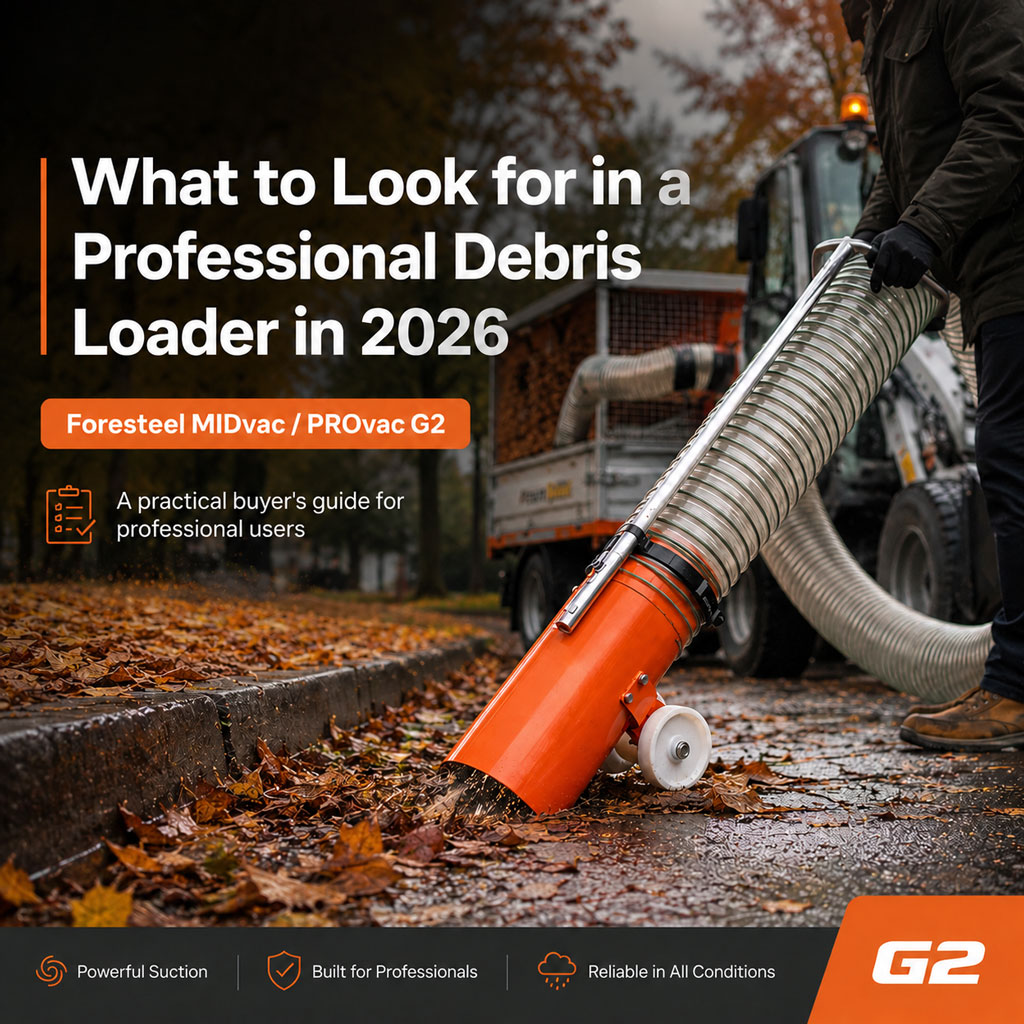
What to Look for in a Professional Debris Loader in 2026
A professional debris loader needs to survive daily use across a 3-6 month season, handle variable materials from dry leaves to wet debris, and deliver consistent performance year after year. The machines that meet this standard are not the same as the ones that look good in a catalogue at the lowest price point.
Here is what actually separates professional-grade debris loaders from equipment that will cost you more in downtime and replacements than it saved at purchase.
Housing and Wear Areas
The impeller and housing are the highest-wear components on any debris loader. Material enters at speed, gets shredded by the impeller, and impacts the housing walls thousands of times per hour. Over a full season, this adds up to enormous abrasive wear. And that’s expected.
These differences are invisible on a spec sheet and obvious in use. We ran conifer branches, pine cones, wood chippings and gravel through a G2 on camera to show what abrasive material actually does once it is past the nozzle.
Professional units, like ours, use wear-resistant steel — Hardox from SSAB is the benchmark here — in the housing, impeller, shredder blade and other high-impact areas. Hardox steel lasts ~3–5 times longer than standard mild steel under the same conditions. A housing that needs replacement after 1 season versus one thats lifespan can be extended with low cost wear plates and lasts 10+ seasons is a cost difference that dwarfs any savings at the initial purchase.
Engine Choice
The engine powers the impeller at high RPM for hours daily during peak season. It needs to start reliably, run consistently under load, and have parts and service support available wherever you operate.
Briggs & Stratton Vanguard series engines are the most common choice in professional debris loaders for good reason — proven durability, strong parts availability globally, and service networks that cover both Europe and North America. EFI (electronic fuel injection) variants offer improved cold-weather starting and better fuel efficiency.
Be cautious with no-name or generic engines at lower price points. Saving €1000 on the engine that runs hundreds of hours per season is a false economy if parts are hard to source or local mechanics are not familiar with the platform.
Impeller Design
The impeller does two critical jobs simultaneously: creating suction and shredding material. Its design determines how effectively the machine handles different materials, how much volume reduction you actually achieve, and how prone the system is to clogging.
Look for balanced impellers (reduces vibration and bearing wear), sufficient blade mass for momentum through wet and heavy material, and high quality materials.
Hose and Chute Ergonomics
Operators work with the suction hose for hours. Hose diameter, weight, flexibility, and the design of the intake nozzle directly affect both productivity and operator fatigue. A 200mm (8-inch) hose handles most material including wet leaves without clogging. Lighter, more flexible hose sections reduce operator strain over a full workday. Operator ergonomics are often increased by an articulated hose holder arm, taking strain and load off the worker. This has proven to increase work time by 30%.
Serviceability
The best machine is the one that stays running. Evaluate how easy it is to access the impeller for inspection and cleaning. Whether wear parts (impeller blades, shredders, wear liners) can be replaced without major disassembly. How filter changes and routine maintenance are accessed. And whether the manufacturer provides clear service documentation and support.
Total Cost of Ownership
Purchase price is the start, not the end. The true cost over 5–10 years includes fuel consumption per season, wear part replacement frequency and cost, service labor (complex machines cost more to maintain), downtime during peak season (the most expensive cost of all — lost productivity), and resale value.
A €6,000 machine that runs reliably for 10 years with minimal wear part costs is dramatically cheaper to own than an €3,000 machine that needs major replacement at year 1, engine work at year 2, and costs you two days of peak-season downtime per year.
Compare professional debris loaders: See the Foresteel G2 range built with Hardox wear steel and Vanguard engines, or read the full Municipal Leaf Collection Guide.

 Compact, efficient professional equipment