



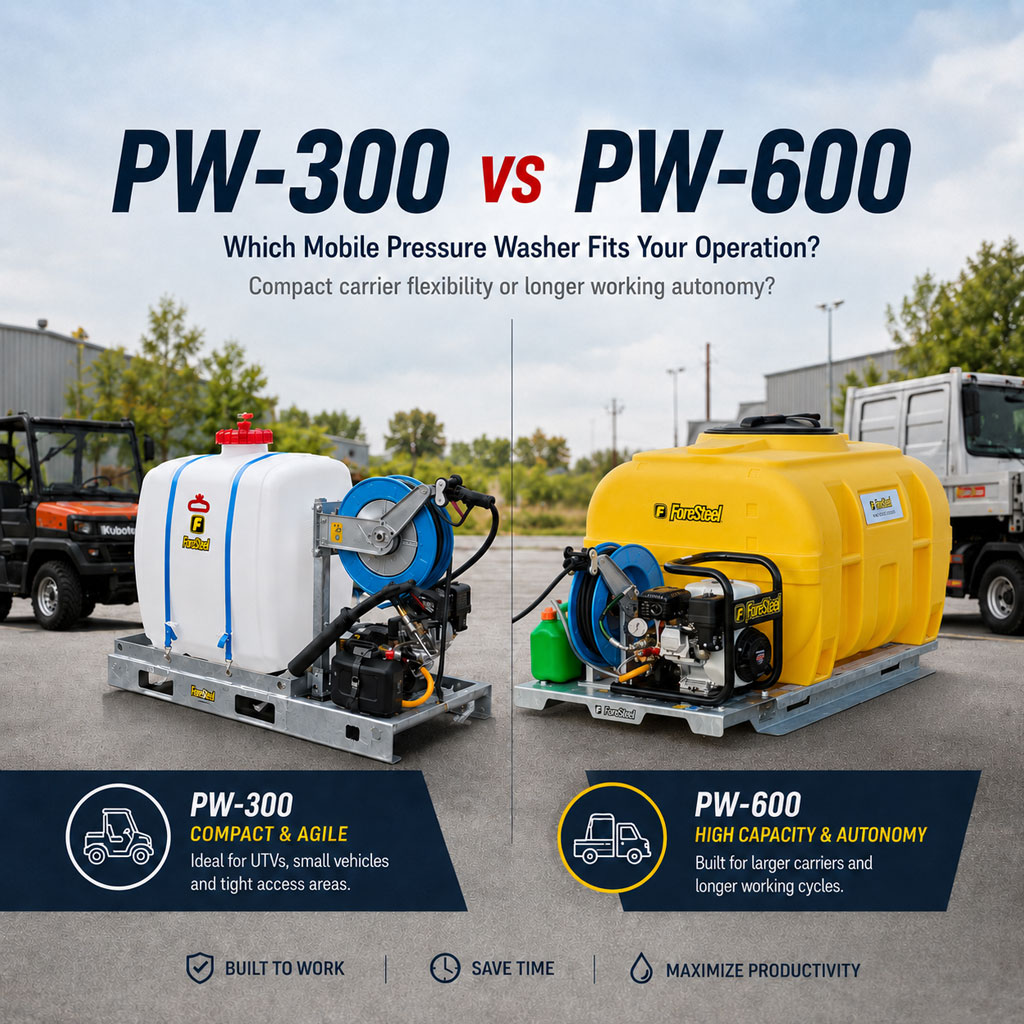
PW-300 vs PW-600: Which Mobile Pressure Washer Fits Your Operation?
The PW-300 and PW-600 are both self-contained mobile pressure washers built on the same design philosophy: water tank, pressure pump, hose system, and chemical dosing on a single forkliftable steel frame. No external water or power needed. Load onto any vehicle and start working.
The difference is tank capacity — and that difference changes which operations each model fits best. Here is how to decide.
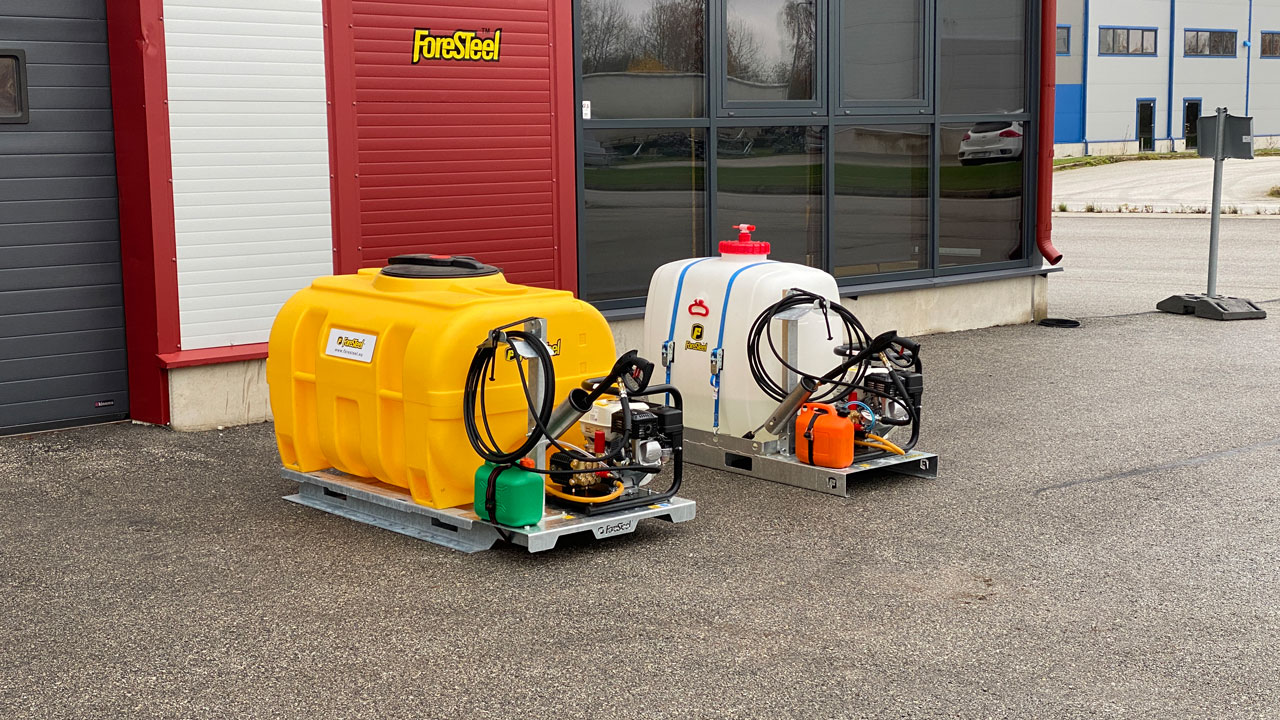
Quick Comparison
| Specification | PW-300 | PW-600 |
|---|---|---|
| Tank capacity | 300 liters | 600 liters |
| Working time per fill | ~30–45 minutes (continuous 100% throttle work) ~1.5-3 hours of actual work with pauses. |
~60–90 minutes (continuous 100% throttle work) ~3-6 hours of actual work with pauses. |
| Stops per fill (typical) | 8–12 (bus shelters), 2–3 (vehicles) | 15–20 (bus shelters), 5–7 (vehicles) |
| Weight empty | ~95 kg | ~180 kg |
| Weight full | ~395 kg | ~780 kg |
| Dimensions | L1350 x W600 x H990 mm | L1700 x W950 x H980 mm |
| Footprint | Compact — fits UTVs, vans, small pickups | Larger — pickups, flatbeds, trailers |
| Forklift pockets | Yes | Yes, 4-way |
| Chemical dosing | Standard, including tank | Standard, including tank |
| Auto hose reel | Optional | Optional |
Choose the PW-300 When…
Your vehicle is compact. The PW-300 fits on UTVs (Kubota RTV, John Deere Gator, Polaris Ranger), golf carts, small vans, and compact pickups. At ~380 kg full, it stays within the payload limits of most small utility vehicles. If your operation runs primarily on UTVs or compact carriers, the PW-300 is the model that fits.
Your stops are close together. For route-based cleaning where stops are 1–5 minutes apart (bus shelters along a road, park furniture across a single park, a campus building circuit), 300 liters covers 8–12 stops before refilling. If a refill point is within a short detour on the route, the smaller tank is no limitation.
You need to move the unit frequently between vehicles. At 80 kg empty, one person can reposition the PW-300 with a pallet jack. It lifts on and off vehicles quickly, making it practical for operations where the pressure washer shares a vehicle with other equipment or moves between fleet vehicles daily.
Budget is the primary constraint. The PW-300 delivers the full autonomous washing capability at a lower entry price. For municipalities testing mobile cleaning for the first time, it proves the concept before committing to the larger model.
Choose the PW-600 When…
Your route is long with limited refill options. For rural municipalities where bus shelters are spread across 20+ km, or for fleet washing operations where you need to clean 5–7 machines before returning to a water source, the 600L tank provides working autonomy that the 300L cannot match.
You operate from a pickup or flatbed. At ~710 kg full, the PW-600 needs a vehicle with appropriate payload capacity. Standard pickups (Hilux, L200, Ranger) and flatbed trucks handle this comfortably. The additional tank capacity makes the most of the vehicle’s carrying capability.
You want maximum efficiency per refill stop. Every refill interrupts the working rhythm. On a long route, cutting refill stops from 3 to 1 per day saves 30–45 minutes of driving and filling time. Over a weekly cleaning schedule, that compounds into hours.
You plan to add an automatic hose reel. The auto reel option — which speeds up deployment and retraction at each stop — is available on the PW-600. For high-frequency route work (15+ stops per day), the auto reel pays for itself in time savings within weeks.
What Both Models Share
The core design is identical: forkliftable steel subframe, self-contained gasoline pump (no external power), External by-pass valve system, integrated chemical dosing capability, and vehicle-agnostic mounting. Both are fully autonomous — no mains water, no mains power, no fixed infrastructure needed.
Both are built to professional standards for daily commercial use. The choice is purely about matching tank capacity and physical dimensions to your specific vehicle fleet and route requirements.
The Decision in Practice
If you are unsure, start with this question: what vehicle will carry the pressure washer most of the time?
UTV or compact vehicle → PW-300.
Pickup, flatbed, or van → either model works; choose based on route length.
Dedicated cleaning vehicle → PW-600 for maximum autonomy.
Compare both models: PW-300 details | PW-600 details | Ask us for a recommendation based on your route profile.

 Compact, efficient professional equipment