



How to Reduce Leaf Collection Time by 50–80% (Real Workflow Breakdown)
Most of the time spent on leaf collection is not actually spent collecting leaves. It is spent on handling, loading, transporting, dumping, and returning — the steps around the collection. Reducing total leaf collection time by 50–80% is realistic for most operations, and it comes from eliminating these surrounding steps rather than simply working faster.
Where the Time Actually Goes

Take a typical municipal leaf collection day using manual methods. A 2-person crew working a 2-hectare park with basic equipment (blowers, rakes, a utility trailer with no vacuum or shredder):
A park of this size with mature trees produces roughly 40–60 m³ of loose unshredded leaves per clearing pass during peak season. With a standard 2 m³ utility trailer, that means 20–30 trailer loads per full clearing.
Each load cycle looks like this:
| Activity | Time per load cycle |
|---|---|
| Blowing/raking leaves into piles (covering ~600–800 m² per cycle) | 30–45 min |
| Loading piles into trailer by hand (pitchfork, rake) | 20–30 min |
| Transport to dump/compost site | 10–15 min |
| Manual unloading (no hydraulic tip) | 10–15 min |
| Return to work area | 10–15 min |
| Repositioning, short break | 5–10 min |
| Total per load cycle | ~90–130 min |
With 20–30 load cycles needed for a full 2-hectare clearing, the total time is roughly 30–50 working hours (2 workers × 3–5 full working days). And this repeats every 2–3 weeks during peak season — typically 4–6 passes per autumn.
The breakdown is striking: only about 30% of the total time goes to actual leaf collection (blowing and raking). The other 70% is loading, driving, unloading, and returning. The crew spends most of the day moving leaves, not collecting them.
The Same Park With a Leaf Vacuum Trailer
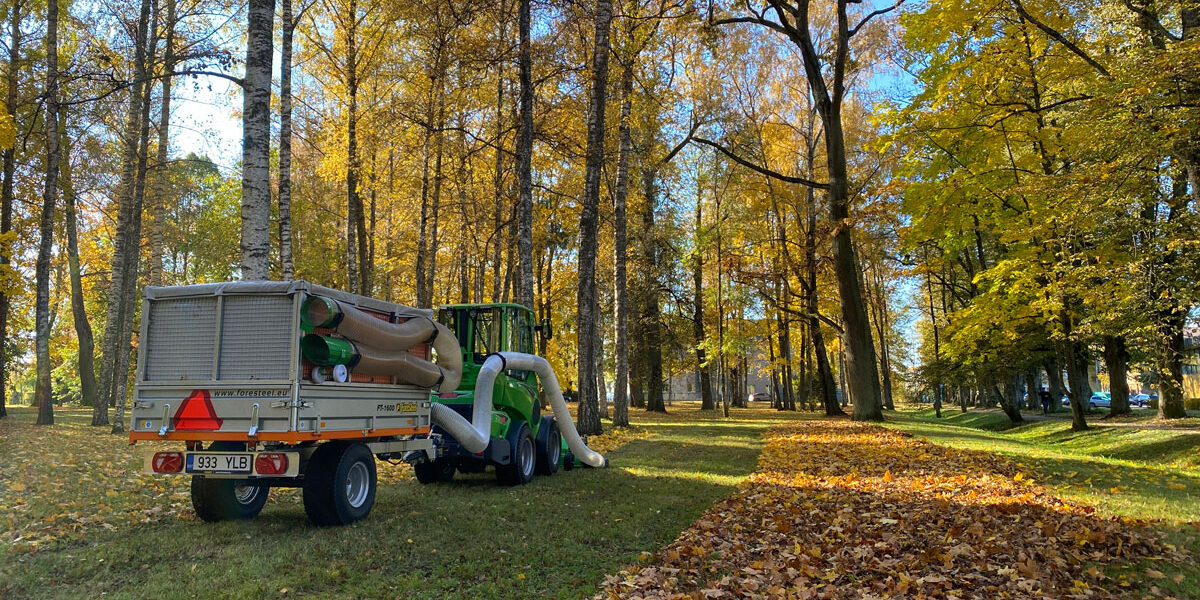
One operator with a leaf vacuum trailer (2.5 m³ capacity, integrated shredder):
The shredder reduces leaf volume by roughly 4:1 to 10:1 depending on leaf type, moisture, and branch content. That means 40–60 m³ of loose leaves compresses to 4–15 m³ of shredded material — roughly 2–6 trailer loads instead of 20–30.
| Activity | Time |
|---|---|
| Direct vacuum collection across 2 hectares (driving + vacuuming) | 5–7 hours |
| Transport to dump site (2–6 trips) | 30–90 min total |
| Hydraulic tipping at dump site (2–6 tips) | 5–15 min total |
| Return trips | 30–90 min total |
| Breaks, refueling | 30–45 min |
| Total for complete park clearing | ~7–11 hours (1 operator, 1–1.5 days) |
The Comparison
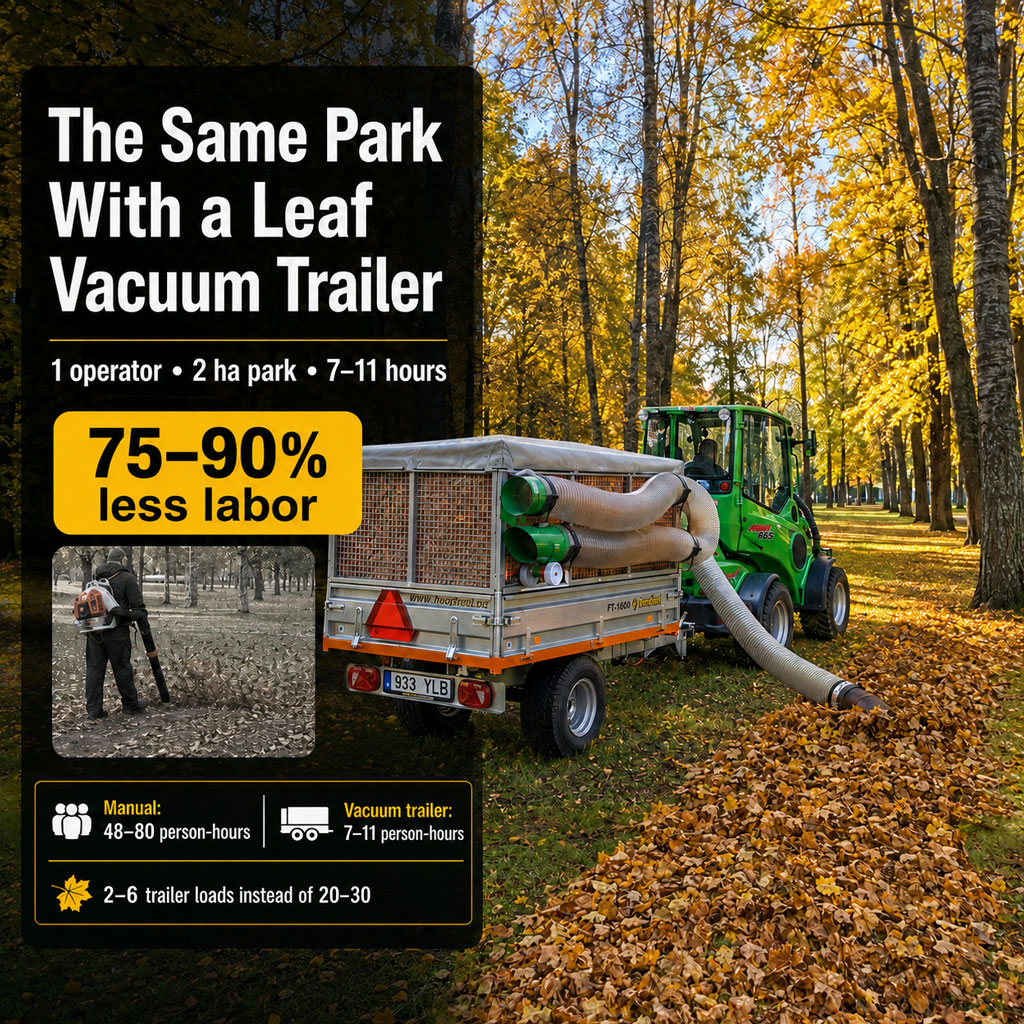
Manual method: 2 workers × 3–5 days = 48–80 person-hours per park clearing
Vacuum trailer: 1 worker × 1–1.5 days = 7–11 person-hours per park clearing
That is a 75–90% reduction in labor for the same result. Over a full season with 4–6 clearings of the same park, the manual method consumes 200–480 person-hours. The vacuum method: 28–66 person-hours. The difference is not marginal — it is transformational.
Why the Difference Is So Large
Three factors compound:
1. Shredding eliminates most transport time. This is the single biggest factor. Without shredding, loose leaves fill a 2 m³ trailer in minutes. The crew spends more time driving to the dump site and back than actually collecting. With 4:1 to 10:1 volume reduction, 2–6 dump trips replace 20–30. That alone cuts total time by 40–50%.
2. Direct vacuum suction eliminates manual loading. Loading loose leaves onto a trailer by hand — even with a pitchfork — is slow, exhausting work. Leaves are light but bulky, they blow away, they compact poorly. Vacuum suction skips this entire step: material goes from the ground directly into the trailer.
3. One operator replaces two or three. Manual methods typically need one person blowing or raking, another loading, sometimes a third driving. A leaf vacuum trailer is a one-person operation from collection through tipping. The crew member freed up can work on other autumn tasks — path clearing, drain maintenance, winter preparation.
What This Means for a Municipal Season Budget
The exact numbers vary by municipality, tree density, and local conditions — but the structure holds everywhere. The manual method costs 5–10x more in person-hours than vacuum collection, and the gap widens with every additional clearing pass.
For a small municipality maintaining several hectares of public green space across 4–6 autumn passes, the person-hour savings from switching to vacuum collection typically exceed the cost of the equipment within the first season. That makes the leaf vacuum trailer one of the fastest-payback investments in the municipal maintenance budget.
The equipment investment for a professional leaf vacuum trailer with EU road approval — is not a seasonal expense. It is a year-round asset: detach the vacuum unit in 30 minutes and the same trailer handles soil, gravel, and mulch transport through spring and summer.
See the efficiency difference for your operation: Read the full Municipal Leaf Collection Guide or explore Foresteel leaf vacuum trailers. For a detailed look at common inefficiencies, see Common Mistakes in Leaf Cleanup.


 Compact, efficient professional equipment